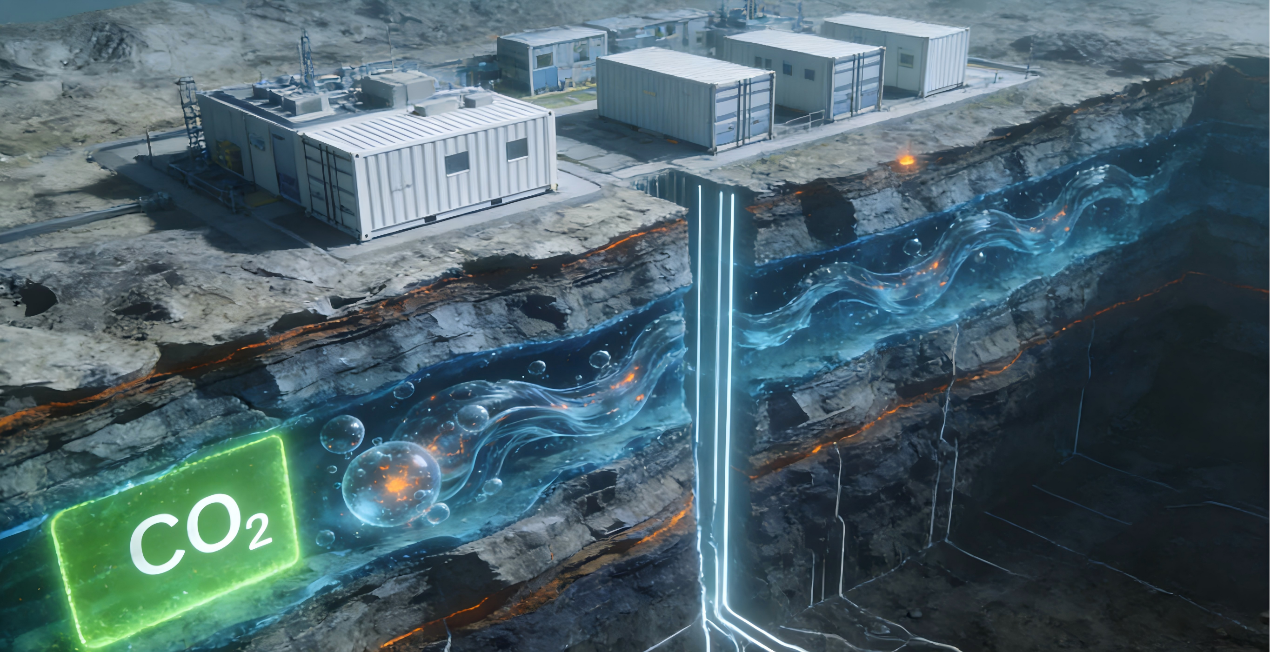
Modeling and Environmental Assessment of CO₂ Storage in Deep HTHP Geological Formations: Coupled THMC Processes, Leakage Control, and Long-Term Subsurface Integrity
Details

Name: Guodong Chen
Affiliation: The University of California, Berkeley and Lawrence Berkeley National Laboratory
Mail: gchen6@lbl.gov
Website:
https://profiles.lbl.gov/541843-guodong-chen/about
https://scholar.google.com.hk/citations?hl=zh-CN&user=U2YFkAgAAAAJ
https://www.scopus.com/authid/detail.uri?authorId=57198649423
Research Interests: subsurface fluid flow, AI for geo-energy development, generative AI for scientific simulation, design and discovery
Research objectives:
Carbon Capture, Utilization, and Storage (CCUS) is widely recognized as a critical strategy for mitigating climate change and reducing atmospheric CO₂ levels. While deep geological formations—such as saline aquifers and depleted reservoirs—offer vast storage potential, their deployment under High-Temperature and High-Pressure (HTHP) conditions raises pressing concerns regarding long-term environmental safety and geological system stability.
This research initiative prioritizes environmental stewardship and subsurface geological integrity over resource recovery. We aim to advance fundamental understanding of the multiphase transport, reactive interactions, and mechanical responses that govern CO₂ behavior in deep geological media. Specifically, we seek to elucidate how CO₂ injection perturbs the natural geochemical and hydrological equilibrium of deep subsurface systems, with direct implications for shallow groundwater protection, caprock sealing performance, and risk of unintended leakage.
To achieve this, we encourage integrative approaches that combine controlled physical experiments, rigorous mathematical modeling based on partial differential equations (PDEs), and AI-enhanced simulation frameworks. Contributions should address either: (i) Environmental earth science questions related to CO₂ fate, plume containment, and ecosystem safeguards, or (ii) Modeling, control, or optimization methodologies involving differential equations, inverse problems, or intelligent control of subsurface flow processes.
We welcome original research and comprehensive reviews that bridge environmental geoscience with applied mathematics and control theory, ultimately supporting safe, predictable, and monitorable geological carbon storage.
Subtopics:
(1) Transport Phenomena and Environmental Fate of CO₂ in Deep Geological Media
Phase equilibria, diffusive–convective transport, and solubility trapping of CO₂ in deep saline aquifers under HTHP conditions, with emphasis on long-term environmental containment and implications for overlying aquifers.
(2) Geological Barrier Integrity and Environmental Risk Assessment
Evaluation of caprock sealing capacity, fault reactivation risks, and gas channeling pathways; development of physics-based risk indicators and monitoring protocols to safeguard shallow environmental resources.
(3) AI-Enhanced Modeling and Control of Subsurface CO₂ Migration
Application of generative AI and machine learning to solve inverse problems in reservoir characterization, predict plume evolution via data-assimilated PDE models, and enable real-time control strategies for leakage prevention—explicitly linking AI outputs to governing differential equations of multiphase flow.
(4) Coupled Thermo-Hydro-Mechanical-Chemical (THMC) Processes in Environmental Geosystems
Investigation of CO₂–fluid–rock interactions and their feedback on porosity-permeability evolution, stress redistribution, and structural stability, formulated through coupled nonlinear PDE systems describing mass, momentum, energy, and species conservation.
(5) Mathematical Modeling and Flow Control in Heterogeneous Porous Media
Development of novel control-theoretic approaches and mobility-reduction strategies (e.g., foam, gels, or smart fluids) to suppress viscous fingering and improve sweep efficiency, supported by rigorous analysis of stability, controllability, and optimal injection policies governed by nonlinear parabolic/hyperbolic PDEs.
Keywords:
- Geological Carbon Sequestration
- Deep Subsurface Environmental Safety
- Multiphase Flow in Porous Media
- Environmental Risk Assessment and Groundwater Protection
- Coupled THMC Processes
- Partial Differential Equations in Subsurface Flow
- AI for Environmental Simulation and Control
- Caprock Integrity and Leakage Prevention
Expected Outcomes:
Academic: Peer-reviewed articles
Co-academic leads:
Zongfa Li
Affiliation: School of Petroleum Engineering, Yangtze University
E-Mail: lizf@yangtzeu.edu.cn
Website: https://pec.yangtzeu.edu.cn/info/1022/6296.htm
Scopus link:https://www.scopus.com/authid/detail.uri?authorId=57222815722
Research Interests: CO₂ Enhanced Oil Recovery and Geological Sequestration, Gas Injection for Enhanced Oil Recovery, Intelligent Oil and Gas Development, Intelligent Optimization of Profile Control and Plugging in High Water-Cut Reservoirs
Chuanyin Jiang
Affiliation: Uppsala University
E-Mail: chuanyin.jiang@geo.uu.se
Website: https://www.uu.se/en/contact-and-organisation/staff?query=N23-2335
Scopus link:https://www.scopus.com/authid/detail.uri?authorId=57204197376
Research Interests: Department of Earth Sciences; Program for Air, Water and Landscape Sciences; Hydrology
Published Papers:
Channeling paths identification and mitigation by using integrated profile control and flooding based on meshless connection element method
Wei Yong, Zhijie Wei, Jian Zhang, Wensheng Zhou, Yuyang Liu, Wentao Zhan, Wei Liu, Yixin Zhang, Jiaxu Mei
Article ID: 4327

